
How Students Can Use AI Responsibly for Homework and Learning
- Parents/Students
- July 31, 2026
- Saloni Sacheti
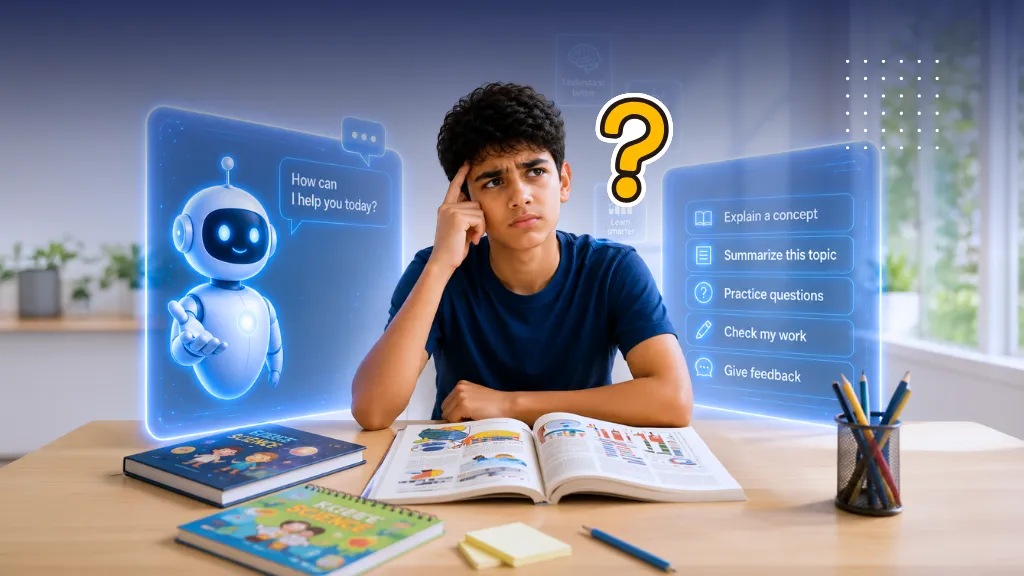
There is a moment most parents recognise. You walk past your child’s room, glance at the screen, and see them typing into an AI chatbot. Not Google. Not a textbook. Not even a YouTube tutorial. An AI.
Your first instinct might be concern. Is this cheating? Are they actually learning anything? What happens when the exam comes and there is no AI to help?
These are fair questions, and they deserve honest answers. The students who know how to use it well will thrive. Those who misuse it, or whose schools and parents never talk to them about it, may end up worse off than if they had never used it at all.
This is the conversation that needs to happen now.
AI Is Changing How Students Learn, But Not What Learning Actually Means
Let us be clear about what AI can and cannot do.
AI can explain a difficult concept in five different ways until one clicks. It can summarise a long chapter, generate practice questions, check grammar, and give instant feedback. For a student stuck at 10 pm with a science concept they do not understand, it is genuinely useful.
But AI cannot want to learn for your child. It cannot sit the exam. And it definitely cannot think for them.
Learning takes place in the student’s mind, not in the chatbot. AI can open the door, but the student needs to take the next step.
The real risk is not AI itself but its passive use. If students treat AI as a shortcut rather than a supportive tool, they may copy rather than understand. This false confidence disappears as soon as AI is not available.
For students, using AI responsibly means staying in control at all times.
The Biggest Misconception About AI in Education
If you ask most students what AI is for, they will say it gives you answers. This is a common misconception, and it is holding them back. The most successful learners, who will continue to do well in the future, use AI differently. They treat it as a thinking partner, not just an answer machine. Here is what that difference looks like in practice:
- Wrong: “Write my essay on the water cycle.”
- Better: “Help me understand what the water cycle is, and then ask me questions about it.”
- Wrong: “What is the answer to this maths problem?”
- Better: “Walk me through how to solve this type of problem step by step.”
- Wrong: “Summarise this chapter for me.”
- Better: “I read this chapter. Quiz me on it and tell me what I missed.”
The difference is not effort. It is intent. One approach produces a finished task. The other produces a student who actually learned something.
From Homework Solver to Learning Coach: What Responsible AI Use Looks Like
1. Use AI to Understand, Not to Copy
When a student gets a low mark and does not know why, that is a learning moment. When AI writes the assignment and never engages with the content, that moment disappears.
Encourage students to use AI to request simpler explanations, real-life examples, and alternative perspectives on the same concept. The goal is comprehension, not completion.
2. Use AI to Ask Better Questions
This one surprises most people. AI is not just good at answering questions. It is exceptional at helping students form better ones.
A student who asks AI to generate discussion questions, debate prompts, or deeper explorations of a topic is developing inquiry skills that will serve them in school and beyond. That is AI-assisted learning at its best.
3. Use AI to Practise Retrieval
Retrieval practice, which means testing yourself on material instead of just rereading it, is one of the most well-established learning strategies in educational research. AI makes this process easier than ever.
Students can ask AI to quiz them, create flashcards, build mock exam questions, or simulate a verbal test. This is not cheating. This is smart studying.
4. Use AI to Improve, Not Replace, Your Own Work
There is a form of AI use that every teacher and parent should encourage: a student who writes a first draft themselves and then asks AI for feedback.
“What is unclear in this paragraph?” “How can I make this argument stronger?” “Does my conclusion match my introduction?”
These are the questions of a student who is learning. The voice in the final piece remains theirs. AI just helped them make it better.
The Four Habits of AI-Literate Students
These are the habits that separate students who grow with AI from those who quietly fall behind.
1. Verify
AI can be wrong, and it can be wrong confidently. Students need to treat AI-generated information the way they would treat a peer’s notes: useful, but not the final word. Cross-checking with textbooks, teachers, and credible sources is non-negotiable.
2. Question
The first answer is rarely the best answer. AI-literate students push back, ask follow-ups, and challenge responses. “Are you sure?” “Can you explain that differently?” “What is the other side of this argument?”
3. Reflect
After every AI interaction, the most important question a student can ask is: Do I actually understand this now? Not only did I get the answer, but I also understand it. That habit of reflection is what transforms the use of AI into real learning.
4. Disclose
Schools are still working on their policies about AI and academic honesty. Students should know their school’s guidelines and follow them not just because someone is watching, but because honesty is an important character trait.
Which AI habit matters most?
When AI Stops Helping — and Starts Hurting
The Dependency Trap
Students who let AI do most of the thinking might finish their homework more quickly. However, they are not developing the mental skills needed for exams, interviews, and life after school. Quick results now can mean more challenges later.
The Critical Thinking Gap
Problem-solving is a skill that grows through being exercised. Every time AI does the reasoning for a student, it is a missed opportunity for repetition. Over time, the gap between what a student can do with AI and what they can do alone becomes uncomfortably wide.
The Confidence Illusion
One of the biggest risks is that AI can produce answers that sound convincing, even when they are wrong. If a student reads a well-written paragraph and assumes it is correct without questioning, checking, or thinking carefully, they have not learned how to learn. They have only learned to copy in a more complicated way.
The goal was never to produce a finished assignment. The goal has always been to develop a student who can think.
Why AI Literacy Matters More Than AI Access
Here is something worth sitting with: almost every student in the world will have access to AI tools within the next few years. Access is not the differentiator anymore.
Judgment is.
The students who will thrive are not the ones with the best AI tools. They are the ones who know how to evaluate information, detect when something sounds right but is not, make ethical decisions about what to use and what to disclose, and think independently even when a shortcut is available.
This is what AI literacy for students really means. It is not just about knowing how to use AI, but also knowing when to use it, how to question it, and how to stay in control of their own learning.
For parents and teachers, the job is not to ban AI or to simply allow it. It is to have ongoing, honest conversations about what good use looks like. To model critical thinking. To ask students not “Did you finish your homework?” but “Do you understand it?”
A Simple Framework for Every Student: Think First, AI Second
If there is one thing to take away from this blog, let it be this:
Before AI:
Attempt the problem yourself. Even partially. Even badly. The struggle is where the learning begins.
With AI:
Ask for guidance, explanations, and examples. Use it to help you understand, not to skip the learning process.
After AI:
Verify what you learned. Reflect on whether you actually understand it. Rewrite in your own words.
This approach is not against AI. It is focused on supporting learning.
The Students Who Will Thrive
The future will not belong to students who use AI the most. It will belong to those who learn to work with AI thoughtfully, purposefully, and with genuine curiosity.
Education has never been about memorising answers. It has always been about developing the ability to think, question, create, and solve problems. AI can support that journey. But only when the student remains an active participant in their own learning.
For parents: this conversation is important. It should not be a lecture but a real, curious discussion about how your child is using AI and what they are learning from it.
For teachers: students who arrive in your classroom with already-established responsible AI habits will be your most capable learners. Those who have not will need your help building those habits now.
The question was never whether students should use AI. It was always whether anyone was going to help them use it well.
Explore AI-Powered Learning with Viva AI Buddy
Looking for a responsible way to use AI for learning?
Viva AI Buddy, available through the QR codes in every chapter of Viva Education books, helps students revise concepts, access chapter summaries, practise with worksheets, and strengthen their understanding through AI-powered support.
Scan the QR code in your book to get started and discover how AI can become your learning companion—not your shortcut.
Frequently Asked Questions (FAQs)
1. How can students use AI responsibly for homework?
Students can use AI responsibly by asking for explanations, examples, feedback, quizzes, and study support rather than copying answers. AI should help students understand concepts, not complete assignments on their behalf.
2. Is using AI for homework considered cheating?
Using AI is not necessarily cheating. It depends on how it is used and whether it follows school guidelines. Using AI to learn, revise, and improve understanding is different from submitting AI-generated work as one’s own.
3. What are the benefits of AI in education?
AI can provide personalised learning support, explain difficult concepts, generate practice questions, offer instant feedback, improve writing skills, and help students study more effectively.
4. Why is AI literacy important for students?
AI literacy helps students evaluate information, verify facts, identify inaccuracies, use technology ethically, and make informed decisions about when and how to use AI in their learning.
5. Can AI replace teachers or traditional learning methods?
No. AI can support learning, but it cannot replace teachers, classroom discussions, critical thinking, or human guidance. Effective learning still depends on student engagement and teacher support.
6. How can parents encourage responsible AI use at home?
Parents can discuss how their children use AI, encourage fact-checking, ask questions about what they learned, and help them see AI as a learning assistant rather than a shortcut.
7. What are the risks of relying too much on AI for learning?
Overreliance on AI can reduce critical thinking, weaken problem-solving skills, create dependency, and give students false confidence if they accept AI-generated information without verification.
8. What is the best way for students to use AI while studying?
A simple approach is: Think First, AI Second. Attempt the task independently, use AI for guidance and explanations, and then verify and reflect on what you learned.
Share on:
Written by:






Artificial intelligence education is must for all students
Ye hmare students ke liye bahut fayda hai AI ki study such me bachho ko ek new direction deti hai jo unke soch samajh ko viksit karti hai
Well said! AI has the potential to support students’ learning journey while helping them develop critical thinking and problem-solving skills.
Ai is very helpfull for us and easy to learn anything
Business cbse ch1
Please email your query to response@vivagroupindia.in.