Are We Raising Problem Solvers or Marks Scorers?
- Parents/Schools
- July 17, 2026
- Saloni Sacheti
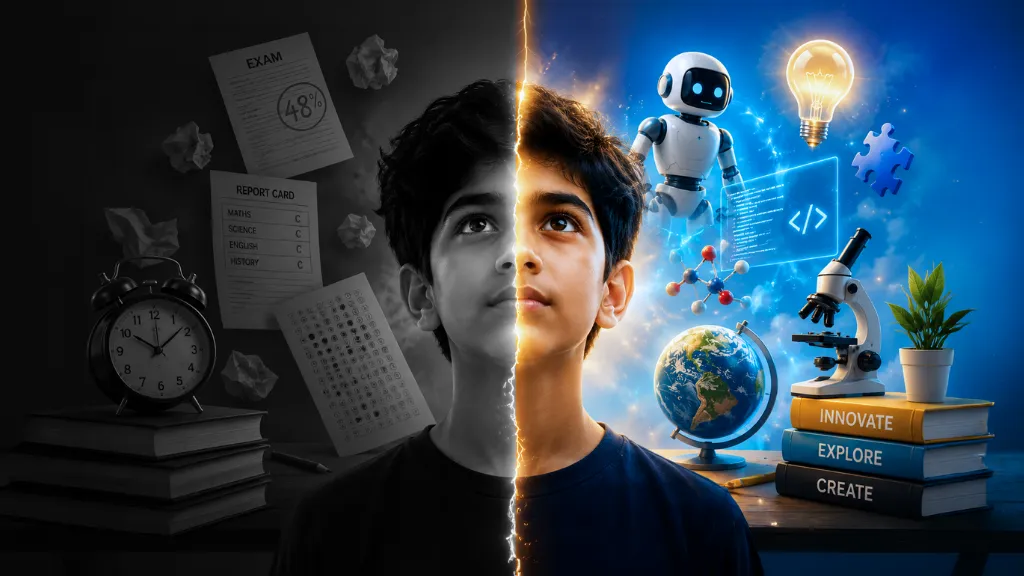
Walk into almost any school today, and you’ll find students preparing for tests, completing assignments, and striving for higher grades. Marks have long been viewed as the most visible indicator of academic success. Report cards, rankings, and examination results often shape how students, parents, and even schools measure achievement.
But in a world changing faster than ever before, an important question deserves our attention:
Are we raising problem solvers or simply marks scorers?
The answer matters because the future our children will inherit demands far more than the ability to reproduce information in an examination hall.
The Traditional Definition of Success
For generations, academic performance has been closely linked with opportunities for higher education and career advancement. Naturally, marks became a key benchmark for measuring student achievement.
There are valid reasons for this. Assessments help educators evaluate learning progress, identify gaps, and maintain academic standards. A good score can reflect dedication, discipline, and understanding of a subject.
However, when marks become the sole objective of education, learning often takes a back seat.
Students begin studying to perform well in examinations rather than to understand concepts deeply. Success becomes associated with memorisation rather than mastery, and curiosity is replaced by the pressure to achieve higher scores.
A World That Values More Than Information
The world our students are preparing for is dramatically different from the one previous generations entered.
Artificial Intelligence is automating routine tasks. New careers are emerging while others are evolving rapidly. Information is available at the click of a button, making the ability to recall facts less valuable than the ability to analyse, evaluate, and apply knowledge.
Employers across industries consistently seek individuals who can:
- Solve complex problems
- Think critically
- Communicate effectively
- Collaborate with others
- Adapt to changing situations
- Demonstrate creativity and innovation
- Make informed decisions
- Learn continuously
These are not skills that develop through rote memorisation alone. They are cultivated through meaningful learning experiences that encourage students to think, question, explore, and create.
Learning and Marks: Understanding the Difference
Marks and learning are often treated as the same thing, but they are fundamentally different.
Marks are a measurement.
Learning is a process.
A student may score exceptionally well on an exam after memorising definitions and procedures. Yet that same student may struggle to apply those concepts in a real-world situation.
True learning occurs when students:
- Understand why something works
- Connect ideas across subjects
- Ask thoughtful questions
- Apply knowledge to new situations
- Reflect on mistakes and improve
For example, a child might memorise the principles of environmental conservation for an examination. A deeper learner, however, can identify environmental challenges in their community and propose practical solutions.
The difference lies not in what they know, but in what they can do with what they know.
The Cost of a Marks-Driven Mindset
An excessive focus on marks can have unintended consequences.
Students may become reluctant to take risks because mistakes affect grades. Creativity may decline when there is only one “correct” answer. Curiosity can fade when learning is viewed merely as preparation for tests.
This pressure often contributes to stress and anxiety among students, particularly when their self-worth becomes tied to academic performance.
When success is defined solely by scores, valuable qualities such as resilience, innovation, empathy, leadership, and critical thinking may receive less attention, despite being essential to lifelong success.
How Problem Solvers Are Developed
Problem solvers are not born; they are nurtured.
They emerge from learning environments that encourage exploration rather than memorisation and understanding rather than repetition.
Students develop problem-solving abilities when they are given opportunities to:
- Investigate real-world challenges
- Work on projects and case studies
- Participate in discussions and debates
- Conduct experiments and research
- Collaborate with peers
- Learn from failures and setbacks
- Explore multiple solutions to a problem
These experiences help learners become independent thinkers capable of approaching unfamiliar situations with confidence.
Rather than asking, “What is the right answer?”, problem solvers learn to ask, “What are the possible solutions?”
The Shift Encouraged by NEP 2020 and NCF 2023
Recognising the evolving demands of the future, India’s educational reforms are placing greater emphasis on competency-based and experiential learning.
The National Education Policy (NEP) 2020 and the National Curriculum Framework (NCF) 2023 advocate for a shift away from rote learning towards deeper understanding, skill development, and real-life application of knowledge.
The focus is increasingly on:
- Conceptual clarity
- Critical thinking
- Creativity
- Experiential learning
- Competency development
- Holistic student growth
This transformation reflects a growing understanding that education should prepare students not only for examinations but also for life.
The question is no longer simply, “What has the student learned?”
It is, “What can the student do with what they have learned?”
What Schools and Parents Can Do
Creating future-ready learners requires a collective effort.
Schools Can:
- Encourage inquiry-based learning.
- Incorporate projects and real-world applications.
- Use assessments that evaluate understanding and skills.
- Promote collaboration and communication.
- Create opportunities for creativity and innovation.
Parents Can:
- Appreciate effort and progress, not just grades.
- Encourage children to ask questions.
- Allow room for mistakes and experimentation.
- Support hobbies and interests beyond academics.
- Focus on developing confidence and independence.
When children feel safe exploring and learning from failure, they develop the mindset needed to solve problems and adapt to change.
Success Beyond the Report Card
Marks will continue to play an important role in education. They provide useful feedback and help track academic progress. The goal is not to eliminate assessments or diminish the importance of academic excellence.
Rather, the goal is to ensure that marks remain a by-product of meaningful learning—not the sole purpose of it.
As educators and parents, we must strive to create environments where curiosity is celebrated, questions are encouraged, and learning extends beyond textbooks and examinations.
Because the future will not belong to those who can simply recall information.
It will belong to those who can think critically, solve problems creatively, collaborate effectively, and continue learning throughout their lives.
The real measure of educational success is not just the marks students earn today, but the challenges they can solve tomorrow.
Frequently Asked Questions (FAQs)
1. Why is problem-solving more important than memorisation in today's world?
Problem-solving equips students to analyse situations, think critically, adapt to change, and apply knowledge in real-life contexts—skills that are increasingly valued in higher education and the workplace.
2. Do marks still matter in education?
Yes, marks remain important for assessing academic progress and identifying learning gaps. However, they should be viewed as one measure of success rather than the sole purpose of learning.
3. What is the difference between learning and scoring marks?
Scoring marks focuses on performance in assessments, while learning involves understanding concepts, applying knowledge, asking questions, and developing skills that can be used beyond the classroom.
4. How can schools encourage problem-solving skills?
Schools can promote inquiry-based learning, project work, discussions, experiments, case studies, collaborative activities, and assessments that focus on application rather than rote recall.
5. How do NEP 2020 and NCF 2023 support future-ready learning?
NEP 2020 and NCF 2023 emphasise competency-based education, critical thinking, experiential learning, creativity, and holistic development to prepare students for real-world challenges.
6. What can parents do to help children become problem solvers?
Parents can encourage curiosity, appreciate effort over results, allow children to learn from mistakes, support independent thinking, and create opportunities for exploration beyond academics.
7. Why can a marks-driven mindset be limiting?
An excessive focus on marks may discourage creativity, risk-taking, and curiosity while increasing stress and anxiety. It can also shift attention away from important life skills such as resilience, communication, and innovation.
Share on:
Written by: